While the photography community is impatiently waiting for a Nikon D700 replacement announcement, I decided to write a review of the Nikon D700 DSLR that I have been shooting with for the past three years. Not sure why it took me so long to write a review of my favorite camera…I guess I focused so much on reviewing new lenses and cameras, that the gear I use every day for my photography has been just sitting at the end of my long “to-do” list. Within the next few weeks I am planning to temporarily reverse the list, start from the bottom and write about other gear that I currently use and used in the past and share my subjective opinion about it.
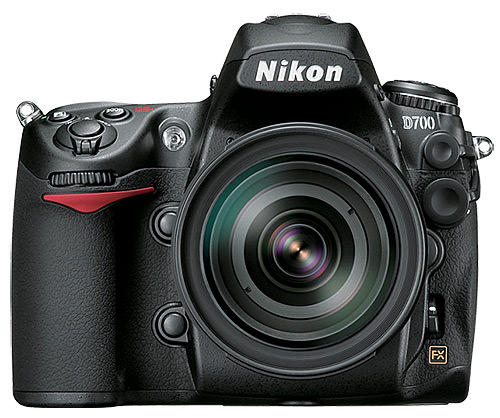
Nikon D700
As you might have already seen on “Our Gear” page, I call the Nikon D700 “the best camera in the world”. Now before rotten tomatoes start flying my way from Canon, Sony, Pentax, Fuji, Leica, Phase One, Hasselblad, Mamiya and other brand fans out there, let me state that this is my opinion that is solely based on my needs. Let me explain. Yes, there are superb Nikon cameras with many more pixels and speed, and there are $40K cameras out there that can shoot 200 Megapixel frames. But when I look at a camera, I weigh in what is important for me first, then pay close attention to the overall price to performance ratio, instead of focusing on a particular feature. The Nikon D700 does not have many megapixels, or high speed, or high dynamic range or movie recording capabilities. In fact, if you look at its bare specs and compare it to all other cameras on the market today, it would probably fall into the “average” category.
Click here to download the above photograph in a large wallpaper format (2560×1600).
So, what makes the D700 the best camera for me? In summary, it is the excellent image quality and high ISO performance, superb autofocus, large viewfinder, great ergonomics, weather-sealing, good speed, the not-too-bulky size and much more…a long list of good reasons at half the price of top-of-the-line professional cameras like Nikon D3s. Let’s take a look at these in more details.
1) Nikon D700 Specifications
Main Features:
- Nikon’s original 12.1-megapixel FX-format (23.9 x 36mm) CMOS sensor: Teamed with Nikon’s exclusive EXPEED digital image processing, the D700 delivers breathtakingly rich image quality.
- Continuous shooting up to 5 frames per second: Shoot at up to 8 frames per second with the optional MB-D10 Multi-power Battery Pack.
- Two Live View shooting modes: Choose from hand-held or tripod modes to suit shooting requirements.
- Fast, accurate 51-point AF with 3D Focus Tracking: Exacting autofocus precision, plus three Dynamic AF modes.
- 1,005-Pixel 3D Color Matrix Metering II: Legendary Nikon exposure accuracy aided by an onboard database of over 30,000 images.
- Nikon Picture Control settings: Advanced color control with 9 customizable settings and 4 preset options allow fine tuning of image appearance preferences.
- Broad ISO sensitivity up to 6400 and incredibly low noise: Super low-noise performance from 200-6400 ISO, with the added versatility of Lo-1 (100 ISO) Hi-1 (12,800 ISO) and Hi-2 (25,600 ISO).
- Three-Inch, super-density 921,000-dot VGA color monitor: High resolution with 170-degree wide-angle viewing, calibrated color and tempered-glass protection assure confident image review.
- Rugged magnesium-alloy construction: Along with extensive dust and moisture protection and a durable shutter mechanism tested to 150,000 cycles, the D700 merges pro D-SLR performance with expanded agility.
- Dynamic Integrated Dust Reduction System: Effective quad-frequency, ultrasonic sensor cleaning minimizes image degrading dust particles.
- Nikon’s exclusive Scene Recognition System: SRS further extends auto-exposure intelligence while also advancing white-balance detection and autofocus performance.
- Active D-Lighting with NEW Auto mode: Unique three-phase dynamic control to capture previously lost details in shadows and highlights while maintaining normalized contrast.
Click here to download the above photograph in a large wallpaper format (2560×1600).
If you skip the typical Nikon marketing garbage above and look at the bare technical specifications, you will see that some of the D700 specs are far from being the best on the market. Yet if you look at the camera as an overall “package”, you will not find a similar competitive product at the same price point. What about the Canon 5D Mark II and the Sony Alpha A900 you might ask? First, read my Canon vs Nikon vs Sony article, then read the next paragraph.
Canon 5D Mark II is a superb camera for high resolution work and video; if you need the megapixels and 1080p movie capabilities, you buy the Canon 5D Mark II. Sony A900 is also great on megapixels and has in-body image stabilization, but performs poorly at high ISOs and has no movie support. The Nikon D700 has the cleanest images at low and high ISOs and comes with Nikon’s best 51-point autofocus system, but cannot record movies. I personally do not care about the movie functionality – I buy cameras for taking pictures, so the video/movie part is not important for me yet (just a nice to have). Resolution is also not critically important for my work – I prefer low noise to high resolution, especially when photographing people and wildlife. As you can see, the D700 is clearly the choice for my type of shooting. So you should also weigh in what is more important for you, without forgetting about your existing investment in lenses, accessories and know-how. I hope this explains why I call the D700 the best camera in the world.

Click here to download the above photograph in a large wallpaper format (1920×1200).
2) Camera construction and handling
Like D300s and other higher-end Nikon DSLRs, the Nikon D700 has a full magnesium-alloy frame. The camera is built tough and will last a long time, if it is properly taken care of. My D700 has survived all kinds of abuse and I shot it in rain, snow, hot, cold, humid and dry weather. I also used it in deserts and sand dunes of California and Colorado with wind blowing sand on the camera at 40-50 miles per hour, occasionally reaching 60+ MPH gusts. I also dropped it a few times (once on concrete ground on its side, about a foot of drop) and nothing happened to it. The D700 survived it all and it is still alive. The only thing that happened to it over the course of three years, is the rubber on the back started peeling off recently as I described in my “Nikon Quality Assurance” article a couple of days ago:
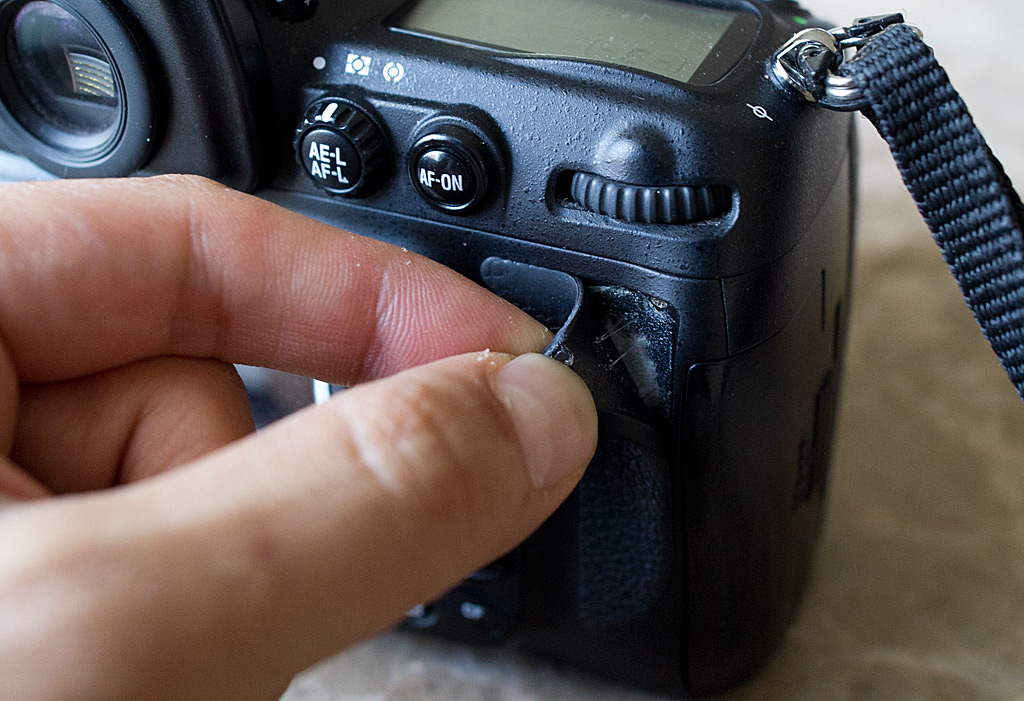
Many of the labels on buttons on the left side of the LCD are also gone, but I am not surprised – after-all, I have been abusing this puppy for over 3 years now. Other than that, the camera is built like a tank.

Click here to download the above photograph in a large wallpaper format (1920×1200).
Handling-wise, the D700 is also excellent. It is slightly heavier and bulkier than the Nikon D300s and has almost exactly the same layout on the front and back, except for the viewfinder area on the back that is borrowed from the Nikon D3. The buttons and controls on the camera are intuitively positioned so that you can quickly get used to them. Except for the top rotating dial, I often change camera settings without looking at the buttons. The camera fits great on hands and balances well with most professional Nikkor lenses.
As for the MB-D10 battery grip, I have one and use it when I need the speed and more battery life. Since I also shoot with the Nikon D3s, I already have bigger and more powerful EN-EL4a batteries, which I frequently use in the MB-D10. On the negative side, when you attach the MB-D10 to the D700, the camera becomes bulkier and heavier than the D3/D3s/D3x cameras. That’s why when Lola shoots with the D700, I remove the grip, because it is too big and too heavy for her. I wish the Nikon D700 had dual card slots like D300s or D3s cameras. It would be nice to be able to shoot into two different cards for fail-over or overflow. I guess the D700 update will have a dual card feature, since even the Nikon D7000 has that capability.
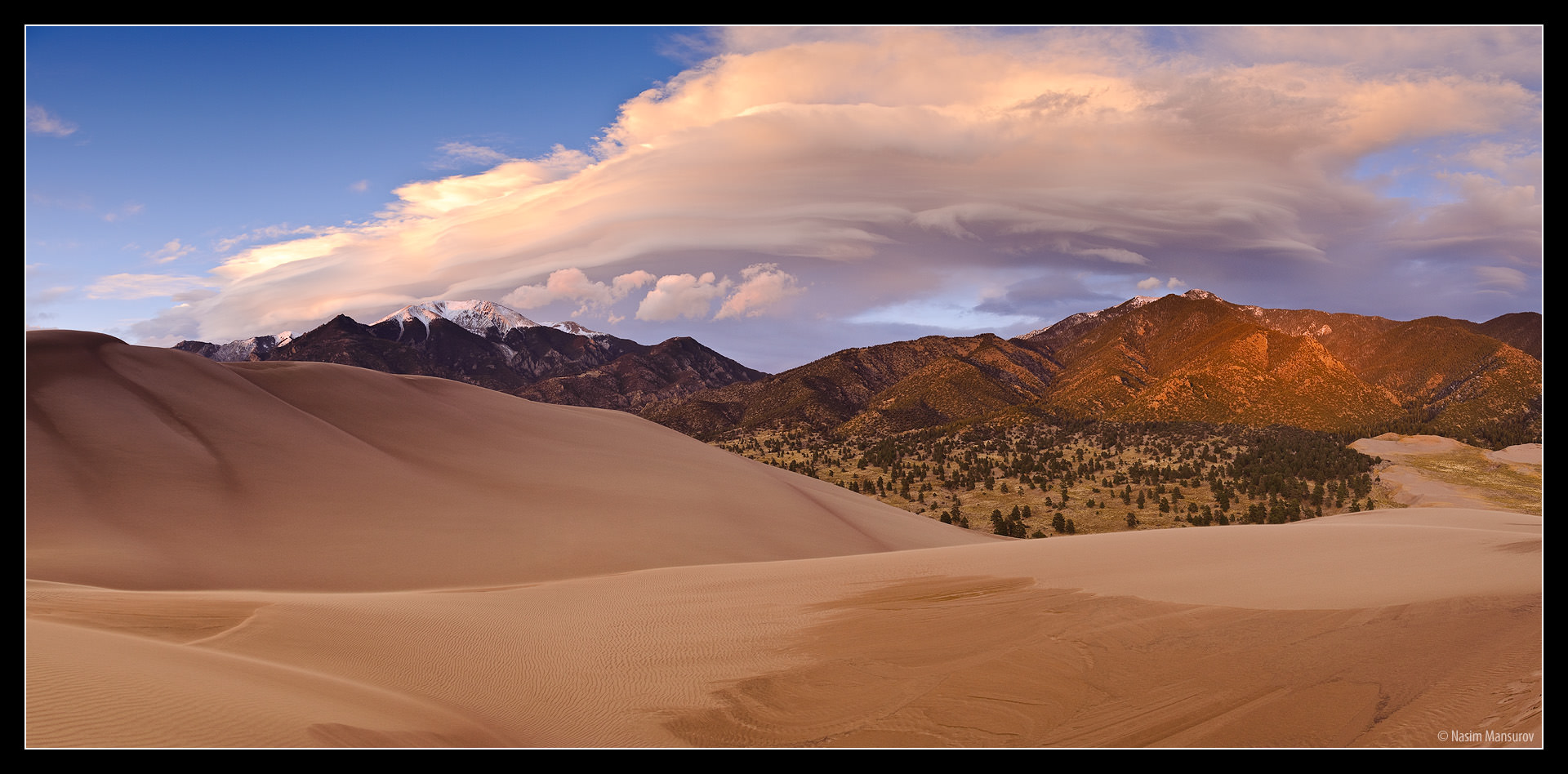
Click here to download the above photograph in a large wallpaper format (1920×948).
3) Camera Sensor
What can I say about the legendary Nikon D3 full frame sensor? Yup, that’s exactly what the D700 has. Currently, the only Nikon sensor that is superior to the Nikon D3/D700 sensor can be found on the Nikon D3s camera. As I have shown in some of my tests before, the difference between the Nikon D700 sensor and the Nikon D3s sensor is roughly 1-1.5 stops. Still, the D700 produces amazing results at high ISOs that even the most current Nikon DX sensors like D7000 cannot match.
Click here to download the above photograph in a large wallpaper format (1920×1131).
4) Autofocus Performance
I remember reading the D700 press release when the camera was announced by Nikon back in 2008. Like many other photographers, I was surprised to see Nikon use the same Multi-CAM 3500FX 51-point AF system found on the D3, instead of putting something slower or inferior. I ordered my D700 as soon as B&H started taking pre-orders, mainly because of the autofocus system and the sensor. Although the Nikon D300s also has a 51-point AF system, it is not in the same league as the AF system on the D700/D3/D3s/D3x cameras. It is both slower and slightly less accurate in comparison (especially in low light). I know that some bird and wildlife photographers will argue with me on this one, but if you have used both D300/D300s and D700 side by side for fast action photography, you will surely notice the difference. In addition, the FX viewfinder is so much larger than any DX viewfinder, that it is easier to see if your subject is out of focus. Talking about the viewfinder, since the D700 has an integrated sensor cleaning system (Nikon D3 did not have one), the frame coverage got reduced to 95%. This means that what you see in your frame is roughly 5% smaller than what you will get in the captured image; I take that in mind before composing shots.
Click here to download the above photograph in a large wallpaper format (1920×1200).
All in all, and I know most pros will agree with me on this, Nikon’s 51-point AF system is still the best on the market today.
5) Metering and Exposure
What about metering and exposure accuracy? While the Nikon D700 features the older 1,005 pixel RGB metering sensor, which has now been replaced by the new 2,016-pixel RGB sensor found on the D7000, I personally like it better than the new one. As I have described in my Nikon D7000 review, the new 2,016-pixel RGB sensor can be tricky to work with, especially if you are used to the 1,005 pixel RGB sensor. The new face recognition patterns, along with the new complex sensor system seem to prioritize skin tones more, often resulting in over-exposure. I mainly shoot in 3D Matrix metering mode (about 90+% of the time) and occasionally in spot and center-weighted metering modes. All three have given me great exposures on the D700 in normal lighting conditions. When the light is tricky, I usually use exposure compensation to get the result I need. There are times when I dial +1 EV and shoot like that for a while and there are times when I dial -1 to -2 for the best exposure. But that does not happen very often – the metering sensor on the D700 is usually very accurate.
Click here to download the above photograph in a large wallpaper format (1920×1200).
6) Shooting Speed (FPS) and Battery Life
Without the MB-D10 battery grip, the Nikon D700 is capable of shooting 5 fps (frames per second). In comparison, the Nikon D300s shoots 6 fps (in JPEG and 12-bit RAW mode) and Nikon D3/D3s/D3x shoot 9 fps. The 5 fps speed is plenty for most photography needs, but wildlife and sports photographers have the option to purchase the MB-D10 battery grip to increase the speed of the D700 to a whopping 8 fps – almost as fast as the top-of-the-line D3/D3s/D3x cameras. To get to 8 fps, however, you will unfortunately need to either use alkaline batteries, or purchase an additional BL-3 chamber cover with an EN-EL4a battery that is used by D3/D3s/D3x cameras. Another $150 worth of extra expenses. Unfortunately, the MB-D10 does not come with the BL-3 chamber cover.
Click here to download the above photograph in a large wallpaper format (1920×1200).
The Nikon D700 is juiced by the EN-EL3e battery, which is almost twice smaller and twice lighter than the EN-EL4a. Unfortunately, it is also four times less efficient – the Nikon EN-EL4a can get up to 4300 shots on a single charge, while the EN-EL3e is rated at 1000 shots max. Starting from the Nikon D7000, the EN-EL3e is now replaced by the more efficient and compact EN-EL15 battery, so the D700 replacement will most likely have the same EN-EL15 battery. The MB-D10 battery grip has also been replaced by the MB-D11 battery grip that takes EN-EL15 batteries. The larger EN-EL4a won’t fit inside the MB-D11 though, so I am not sure if Nikon is planning to provide faster performance with this battery grip on the upcoming D700 update.
7) Dynamic Range
The dynamic range on the D700 is excellent. If you expose your subject correctly, you can recover a lot of details from both the bright and the shadow areas. Many of my landscape images were corrected using simple tools like Fill Light and Graduated Neutral Density filter in Lightroom and I was able to recover a lot of information, especially out of 14-bit RAW files. DxOMark claims the D700 to have 12.2 EVs of dynamic range, which is higher than the dynamic range of the Nikon D3s and any of the Canon DSLRs. The site also claims that the new 16.2 MP DX sensor on the D5100/D7000 has higher dynamic range than any previous Nikon DSLR, putting it second on the list of all cameras tested by DxOMark (including medium format). While the latter sounds too good to be true, I will not argue with DxOMark’s tests, since they have lab data to back up their information.
Click here to download the above photograph in a large wallpaper format (1920×1200).
My field tests have proven that shooting between ISO 200 and 800 is quite acceptable without much loss of dynamic range. Anything beyond ISO 800 will decrease dynamic range dramatically, especially beyond ISO 1600. So when I shoot landscapes (often hand-held), I try to stay below ISO 800. When photographing people and wildlife, on the other hand, I do not hesitate to crank up ISO all the way to 3200 and sometimes even to 6400. There is some loss of detail at ISO 6400 though.
See the next page to see more examples of D700′s ISO performance, along with comparisons against Nikon D300 and D3s.


Nice to read. I love my D700 and in reading your article I have nowhere explored its capabilities. I look forward to many years to come.
I have never found the MP count lacking, and the colour reproduction is fabulous and like you, I have no desire to make movies..this is my camera.
My partner is looking at the 5DmkII, primarily as it is lighter than the 700; but that would concern me for build quality. Wish there was a full-frame Nikon which was lighter, I like the weight and the robustness….but she simply finds it too heavy.
Thanks for the review…look forward to your review of the D4 and D400 when it is finally released. I will wait and may not purchase the D800 when it comes out…I am quite satisfied with my D700. I can only hope Nikon resists the urge to over-featurize the camera…focus on what matters.
Steven, if your partner finds the D700 heavy, she should try holding the D3s :) It would be nice if Nikon released a cheaper and lighter camera with an FX sensor, but I am afraid it is not going to happen any time soon…the 5D Mark II is an excellent camera though!
Looks like we won’t see any new camera announcements this month. If it doesn’t happen in September, then we will have to wait until Q1 of 2012.
The D700 is the best camera I’ve ever owned since the Nikon F. It meets all my photographic needs from portrait to landscape to still-life. I’ve used it to take pictures of historical tapestry and had them enlarged to 20×30 at Costco with no noise or unsharpness. (Note: Don’t laugh at Costco. The cost was $9, and it was printed on Fuji Crystal Archive paper. Flawless.).
I only have one problem with the D700: it’s so good I’m going to have a very hard time justifying the purchase of a new camera (e.g.D800). I know the D700 has only 12.1 MP, but I also know that 99.9% of us don’t need anymore than that. So there it is. It cramps my camera-lust needs, but not my photo needs.
Peter, don’t read about any new camera announcements for the next few years and your NAS will fade away :)
What is worse than NAS is NOCD – Nikon Obsessive Compulsive Disorder.
There is no know long-term cure for this disorder except taking large quantities of Pino Grigio during the introduction period of new Nikon products. Afterwards, the only know longer-term cure is continuous application of WCNS – Wife Continuous Nagging Solution taken 5 times a day.
Stay the couse. Wait 6 month and buy from B&H and address it to your son. Mom’s never challenge their sons. MSN – Mom’s Secret Weakness.
Great article as always! thank you for the review. Please correct section 20 of the article – D7000 to D700
20) Where to buy and availability
B&H is currently selling the Nikon D7000 body only for $2,699 (as of 08/21/2011).
Thank you for pointing out the typo Obed, I fixed it :)
Great review. I am a D90′rs and contemplating D800 arrival. But… my needs is so much like yours in that D700 is already good enough.
Great articles. Thumbs up!
Alex, you won’t be disappointed with the D700 for sure!
Nasim, thank you for posting such a great review! I’m very excited about the D800, but I’ve been curious about your thoughts on the D700. Your reviews are just terrific, and they have guided/will guide my future Nikon purchases.
I have just one issue with your D700 vs D7000 comparison, which is that you didn’t include a sample photo or a discussion of the D7000 at its base ISO of 100. In your review you noted that according to DxOMark, the sensor in the D7000 (also found in the D51000) outperforms the D700 in dynamic range, but you left out that the D7000 also outperforms the D700 in noise, tonal range, and color sensitivity at ISO 100. For tripod users and bright light shooters, this is important to know.
Thank you for your feedback Matt! The D7000 at ISO 100 might be better than D700 in total range and colors, but definitely not in noise. While images at ISO 100 have a very slight grain on the D7000, the D700 produces grain-free images. This has to do with pixel density and size.
Great review!! Nikon D700 is indeed the best camera in the world for me as well! As you rightly pointed out, every photographer has it’s own “best camera in the world”. Mine without doubt is D700 – I have two of them and had been doing wedding photography almost since they came out.. I can’t wish for a better camera! It’s amazing and delivers every time!
Thank you for your feedback Martins! My wife also thinks the D700 is the best camera for weddings :)
I was actually on the fence about getting d700 this late in its product life cycle. But your review finally convince me that this is really a none issue. I’ve ordered mine yesterday at 70% of the usual retail price :)
Moving up from d80 since 5 years, and d7000 a mere 6 months (I’ve sold off my d7000 to another user) – switching to a proven d700 really makes sense since I now owned only fx lens (24-120 f4 and 85 f1.4d).
Can’t wait for my d700 to arrive. Cheers.
Thank you a lot Nasim; as a D700 User I am very happy to read the “better late the never review”;
Very good section about noise performance comparing D300s/D7000; And as you pointed out Noise is also an issue for DX for ISO <= 800; I love the clean images of my D700 and come to the same result;
will use that cam till it dies;
/Karl
You are most welcome Carl, thank you for your feedback..
for me the Nikon D700 will become as famous as the Nikon F4 – a legendary cam in future.
-> Hall of fame!!
/K
It has been documented in a recent popular psychological magazine article (sample size 10,571) that people who bought the Nikon D700 have an intelligence quotient (IQ) of from 120-140. That puts us in the “Very Superior Intelligence” range far beyond the Canon population very top norms.
While we should be kind to our lost Canon brethren, we should also enjoy our enlightened position in the camera world. What is our proof of superiority: We own the best DSLR in the world!
LOL Peter, that’s pretty funny! :)
Hi Nasim,
your reviews are always great, keep them coming!
Small comment: I would replace the fake picture of the D700 with a real one (it’s clearly visible that the one you posted is a photoshop combination of a D3 viewfinder and a D300 body).
Best,
Roland
Roland, where did you see a fake photo of a D700? There is no fake photo here…I would never do that.
At the very top of the review. It looks like the picture that amazon.com has for the D700, which is also not a true representation of the camera.
amazon.co.uk and amazon.de, on the other hand, have a correct picture of the camera.
Wow Roland, thank you so much for pointing it out. I don’t know where I got this image from, but it sure is fake! I got the good one from NikonUSA.com and replaced the image.
You are welcome!
I like the high quality of your reviews and thus thought I should mention this.
All the best,
Roland
I upgraded from a D90 to the D700 in April after trying to hold out for months for the D800. After the earthquake in Japan which damaged the Nikon factory that produces the FX bodies, I figured it would be forever before an official announcement was made. Best of all, the D700 body went on sale for $2,299 (in Canada!…our stuff is always more expensive than in the US) which was a $200 savings from the regular price. At the same time, B&H had just increased their price to $2,699. Gotta love a good deal! No regrets. I love using it. The D3 would never be a consideration for me as I already find the D700 quite heavy (I have a slightly sore right wrist most of the time). I’m using my old, old D40 for a couple of weeks, mainly with the 50mm f/1.4 lens and it seems so teeny, tiny and light compared to my usual D700/24-120mm f/4 “walk-around” combo.
Jane, you are absolutely right! I am now 90% confident that we will not be seeing a D700/D3s replacement this year, so why not take advantage of great deals now?
Thanks Nasim for your brilliant review. Your reviews are best to me as you are a real-world, hands- on photographer with imagery that I find very appealing. I’m in the process of selling some 4×5 equipment with the purchase of a D700 in mind with the money. Your review of this camera may have tipped the scale in favour of my following thru on this purchase.
Thank you for your feedback Michael! :) I am sure you will not be disappointed with the D700. It will allow you to take pictures you could not take before with your 4×5…the ISO performance of the D700 is excellent.
Great review as always! I’ve been telling myself to hold on to my D90 and wait for the D700 upgrade coming end of this month. Hopefully the new body will shine once again.
Cheers
Hi Nasim,
Nice review and yes the d700 is one of the best cameras in the world. I’ve own mine for the past two and a half years and it’s been great. Can’t wait to see what nikon comes with next because of the achievements they made with the d3s sensor. I really hope nikon starts to produce they own sensors to keep they superiority in the photography world because Sony is knocking on they door. Waiting on sony sensors is killing them. Nikon d3, d3s and d700 are nikon made sensors and they are among the best sensors ever made. Hope they pass on the technology to the lower end cameras especially they upcoming mirrorless camera. But I need your opinion on whether you use the active d-lighting or you turn it off? I also got the same peeling off rubber to the back, will just use super glue to fix it. Thanks and awaiting a response to my question.
Also Nasim,
One more thing, I know you shot raw files but what i fine is the color gamut from nikon cameras changes when upload and is ready to process in lightroom or adobe. Do you get that same issue? I also readed that using Capture nx reveals and retains the best portential of the nikon nef raw files. What’s your take on that? I think thats on of the reasons I still rather shot jpegs becuase I like the results i get from jpeg then process in lightroom3.
i just picked up slightly used D700 and wondering what wide angle prime lenses you recommend? I have a 50 1.8 which after using it on a D70 for past couple years, seems so different on FX. Love your outlook on gear.
p.s. I just read you review of the 24 1.4 and although it siunds stunning, i was wondering about smaller and cheaper lenses as well. is there an older wide with manual focus that you’d recommend?
Hi Nasim,
Brilliant review! I can’t seem to decide between Nikon d700 or Canon 5d MkII. I’ve read Canon’s metering and white balance is better than Nikon, but Nikon shines at ISO performance. Canon 5d is cheaper than Nikon d700. Which is the winner?
Andreas, it depends on what you want to do with either. If you are into landscapes, the 5D Mark II might be a better candidate due to higher resolution. For photographing people or anything else that moves, the D700 is better hands down.
Agree with you about comparing the weight and size of D700 with D3S. This is the reason I have D700 and not D3. Thx for review, it’s very well done. ;)
You are most welcome!
Hi Nasim,
I was just curious about your AF preferences with the Camera. Do you always use dynamic AF? I find it hard not to use just the single central point (when using single-shot AF), but I also get the feeling that I’m not exploring my camera’s capabilities when I do so. How do you like to work?
Regards,
Luiz
Luiz, have you seen my Autofocus Modes Explained article?
Yes, thank you! I guess I´ve been using it properly, at least according to your article :)
D700 and 5dm2, which one give a better sharpness for landscapes?
Hi John,
I own a D700 and have already worked for quite some time with a 5D MkII. IMHO, the one that gives you better sharpness is a sturdy Gitzo tripod and Arca/RRS ball-head :)
Seriously, though, they´re both very sharp and have great dynamic range. The question you should be asking yourself is “how big do I want to print?” I shoot mostly street photography and the D700 is a killer tool for that. It´s got less resolution but the files are cleaner at higher ISO´s (which I use quite often) and that (plus faster/more effective AF) gives the D700 an edge over the MkII.
For landscapes, though, AF and high ISO performance shouldn´t matter much on top of that sturdy tripod… Therefore, I´d say the 5D MkII would have an edge over the D700 if you want to go fine-art bigger than A4.
Thank You Nasim for this and other truly great and sincere reviews you put the effort into providing us all with. I agree with You on the D700 being the best camera out there, hands down. If I was only a bit hesitant to get my new D700 late last August with all the hype around the upcoming D800, now almost 5 months after owning this camera and having shot in the Nevada and California deserts, Japan, and lastly the Chilean Atacama high plains, I’m now fully convinced this is the best value-for-money still photography instrument out there today.
After just having read what “seems to be” the firm basic spec-sheet for the upcoming D800, my conviction that the D700 will be one of Nikon’s all-time greatest cameras is even more solid.
The D700 mates really well with the “walk-around” 24-12o F4, is a low-light bliss with the 50 1.4G, and makes the most out of the decent “bang-for-buck” Sigma 50-500 OS zoom. I’m longing for the day in February when I’m scheduled to go get the new 16-35 F4 lens to complete my base lens team for this fabulous camera.
All the best,
Sixto
Hi Nasim,
As usual, great review :) I currently have a D7000 + 17-55mm + 85mm f1.4D + 35mm f1.8. I’ve been eyeing for long now the D700 and would like to know if it’s worth getting one now since D800 is arriving soon. My plan is to get let go the D7000 and the DX lenses and that leaves only the 85mm for D700. I shoot portraits mainly and once a while some landscapes so I’m planning to get a D700 + 50mm f1.4G. Btw, I love my 85mm f1.4D till death although it’s a little hard to get fast focus on the D7000.
If the rumors are true that D800 has 36mp, then I’d find It might not be of great use for me since I need more post-processing power, and it might not be great in low light anymore. What do you think?
Thks in advance :)
Lee
Thank you for this great review Nasim. At this moment i still have my old d2x and my d300. I was thinking off selling my d300(i still love my d2x in low ISO,s and colours) and buy a d700.Afther this review i am shure to buy a d700.
Regards
William
William, you won’t be disappointed with the D700!
I’ve been enjoying your bird photos and reviews of equipment, and had a couple questions, if you don’t mind too much.
I was curious as to whether it’s still worth it to save up for a d7000, even though it is DX? I’m not exactly on a student budget, but it will take me some months to save up for even that – and I’d rather like to get the body, a Nikon 70-300mm lens, and a Nikon 50mm f/1.4 AF-S + accessories (bag, memory cards if need be , etc) by the end of the summer which is when I head to Japan for a couple years for my job.
I’m definitely not a professional photographer and currently only work with a Sony DSC-H3. I’d like to move up because I’m a young birder who’s getting a little frustrated with taking “almost perfect” pictures like this. Mainly, I want to be able to take my unnatural luck with getting close to birds and turn that into pictures I can really zoom in on.
Of course, I’m trying to ask this question on birding forums that deal with camera equipment and photography forums that deal with the birding urge, but it’s starting to get incredibly confusing. There are those who tell me “you’ll only get a decent bird picture with the d700 and this lens (which happens to cost about $2,000).” Then here I am looking at flickr groups that use a d90, a d300, a d200 that take often pretty good or even professional photos and of course there are my decent pictures with a “baby camera” posted -right there- in the first post. Sorry if I seem a little frustrated.
I’m just looking for some advice from a professional photographer who might understand that I’m moving into serious hobbying, and likely not selling my images.
Thanks for reading my questions and I encourage you to keep writing and posting reviews.
Chelsea, the Nikon D7000 is a great camera for any photography, including wildlife photography. If your passion is bird photography, then I would recommend to get something better than the 70-300mm lens. If budget is an issue, I would get the Nikon 300mm f/4 lens, which will deliver superb results, as noted in my “best lenses for wildlife photography” article.
Wildlife photography, especially bird photography, is a very expensive hobby to have :)
sir, i would like to know wich is the best camera for studio photography? is it d700 or d-800
Sir, i use the Nikon D90, but my heart beats for a full Frame Camera (but not my money pocket) just have ben watching a demonstration from th new D800 it’s a great camera, but if you dont’t really won’t video i think the differences are not so great with the D700, i print pixtures not greater then A3 plus so i think about price/quality the d700 is a great choice. I also read your test about the new Nikor 28 -300 mm fulframe lens. Because i not wont to spend my whole fortune (it’s not so great) i think i go for a this 28 -300 mm lens and the d700. Have ben thinking about the D7000 but your test tells me not to do so,( D700 versus D7000). Have the DXO optics pro 6 software maybe this software can make the lens default from the 28 – 300 mm correct. Can you advise me a little bit about this mather
Thank You
Sorry for my englisch !
Don’ have to tell you that your picture are great !!!