Nikon 70-200mm VR II Review
This is an in-depth review of the new professional Nikon AF-S 70-200mm F/2.8G ED VR II lens that was released earlier this year.
The Nikon 70-200mm lens is a professional-grade lens that was introduced by Nikon in early 80's in a shape of 80-200mm f/2.8 constant aperture lens for professional news, sports, wildlife and portrait photographers. Since then, Nikon has been enhancing and redesigning the lens every 4-5 years, making it faster, sharper and more versatile by enhancing the optics and introducing new features.
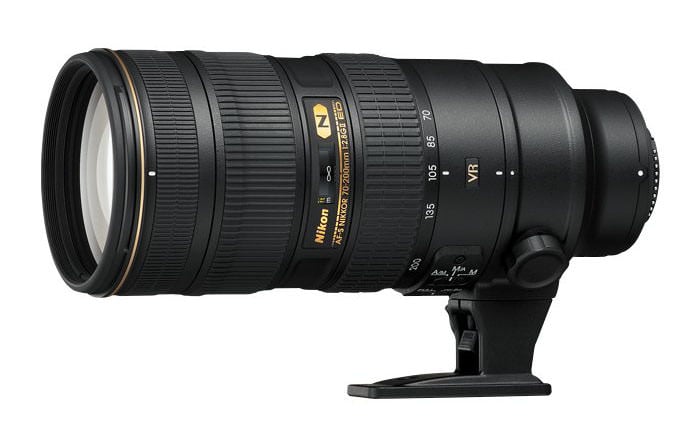
The latest generation of the 70-200mm lens is no exception - Nikon completely redesigned the lens, adding more "ED" (Extra-Low Dispersion) optical elements, making this lens sharper than the previous version. Nikon also added the new "N" (Nano Crystal Coating) to this lens, which is supposed to minimize ghosting and lens flare. Other new features include a brand new "VR II" vibration reduction system, which provides a four stop benefit over non-VR systems and a new "A/M" focus mode for auto-focus priority.
So, compared to the older 70-200mm (which is a superb lens), this lens is supposed to deliver better sharpness and vibration reduction, better resistance to ghosting and flares and less vignetting on full frame bodies (which was a major weakness of the older lens). In this review, I will do my best to provide a thorough analysis of this lens, along with image samples and comparisons against other Nikon lenses.
1) Technical specifications
These are taken from the Nikon press release.
- Focal length: 70-200mm
- Maximum aperture: f/2.8
- Minimum aperture: f/22
- Lens construction: 21 elements in 16 groups (with 7 ED and some Nano Crystal Coat-deposited lens elements)
- Picture angle: 34°20’ - 12°20’ (22°50’ - 8° with Nikon DX format)
- Closest focusing distance: 1.4 m/4.6 ft. (throughout entire zoom range)
- No. of diaphragm blades: 9 (rounded)
- Filter/attachment size: 77mm
- Diameter x length (extension from lens mount): Approximately 87 x 205.5 mm/3.4 x 8.1 in.
- Weight: Approximately 1,540 g/3.4 lb.
2) Lens handling
Just like its predecessors, the new Nikon 70-200mm VR II lens is built like a tank to last a lifetime. It is made of solid metal and can easily withstand tough weather, occasional bumps and is well protected against dust and moisture. The 21 optical elements within the lens, along with the metal body add to the weight - making it 3.4 pounds in total weight, which makes it necessary to hold the lens with one hand, while holding the camera with another. The lens feels solid in hands and the zoom ring is easy to rotate from 70 to 200mm and vice versa. The focus ring is located close to the zoom ring, making it easy to reach it with fingers for manual focus, without having to move the hand to the front of the lens barrel. Compared to the older version of this lens, the zoom ring is a little longer, while the focus ring is a little shorter, which was a smart move by Nikon. After-all, this lens is created for automatic focusing and the focus ring does not get nearly as much use as the zoom ring.
3) Focus acquisition speed and accuracy
When it comes to speed of focus acquisition, the 70-200mm is one of the best performers in the Nikon line of professional lenses. The lens autofocus system with SWM (Silent Wave Motor) is quiet, while focusing is instant and accurate, even in low light conditions. I recently shot a corporate event with this lens and I was amazed at the speed and accuracy of focus when mounted on an FX sensor. Here is a good example of how the lens focuses in a very dim environment:
Click here to see the unprocessed, full JPEG version of the shot (80% Quality @ 1,6 MB).
As you can see in the picture, the room was poorly lit with candles and very dim light and yet the lens focused fast and dead-on, wide open at f/2.8. Out of approximately 250 pictures that I took that day, only about 5 were slightly out of focus, mainly due to the limited amount of light in the meeting room. Quick note: none of the test images have been processed in Photoshop - I extracted them as they were from Lightroom without making any changes.
4) Lens sharpness and contrast
I won't go much into lens sharpness, because you can see all sample images yourself in the next several pages. But if you can't wait, see the large version of the above picture - I shot it at f/2.8. This lens performs so well at f/2.8, that you wouldn't want to shoot it at higher apertures, unless you need to increase the depth of field. In fact, once I saw how good the shots were coming out at f/2.8, I just kept shooting wide open and really loving the results! Best of all, the lens has consistent sharpness across the board, from 70mm all the way to 200mm. Color and contrast have also been improved over the previous 70-200mm.
5) Vibration Reduction - VR II
The new vibration reduction system in this lens is truly amazing! I loved my old 70-200mm, but it made me nervous to shoot it below 1/40-1/50th of a second. After I got the new 70-200mm VRII in my hands, I decided to see what I can get with this lens at much lower shutter speeds. Take a look at this shot:
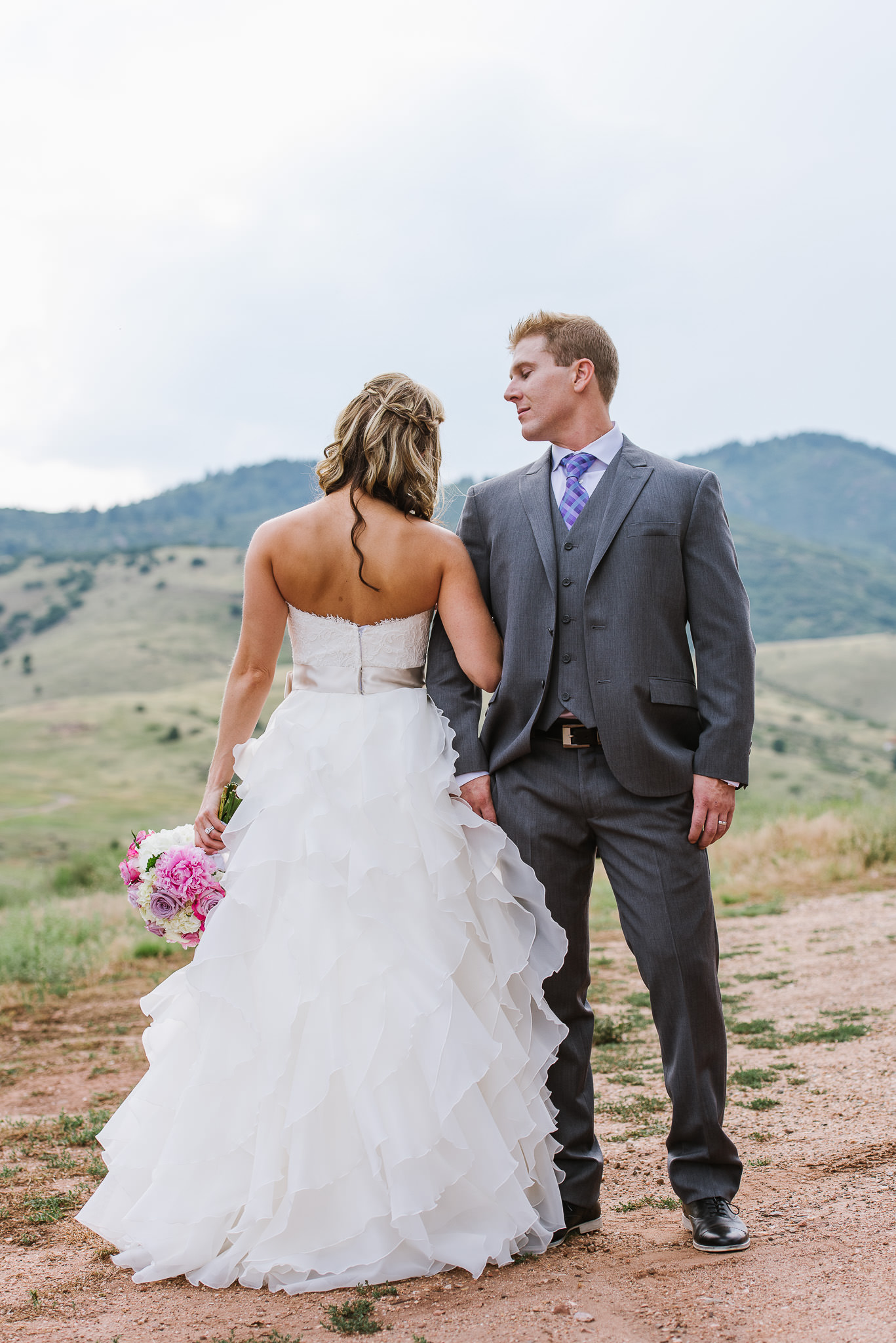
Unbelievable! Tack sharp at 1/13th of a second at f/2.8! Good luck trying the same on the previous 70-200mm! Click here to get the unprocessed, full JPEG (80% Quality @ 1 MB). The new vibration reduction system really works and you can get some magical shots with this lens. Wedding photographers will absolutely love this!
6) Bokeh
The bokeh on 70-200mm lenses has always been outstanding. Although I no longer have my old 70-200mm lens (I sold it at a higher price than what I paid for it 3 years ago) to compare with, I feel that the bokeh actually looks better on this lens than on its predecessor. I went through some of my archived images and I can say that the bokeh on the previous 70-200mm does look a little harsher, although I rarely shot the older lens wide open, due to softness at very large apertures between f/2.8 and f/4.0.
Anyway, I still had to do a bokeh test of this lens against the Nikon cream machine and the king of bokeh - Nikon 85mm f/1.4. Take a look at these image samples:
As you can see, the bokeh on the new 70-200mm VRII is very comparable to the bokeh of 85mm f/1.4 - it is very smooth and "creamy".
7) Vignetting
Vignetting has been greatly reduced at lower focal lengths, but at 200mm it is still quite noticeable when shot against a plain bright background. Nothing to worry about though, as I could not spot vignetting on my images at 200mm - I only noticed it during testing. Here are some test shots that reveal vignetting @ 200mm at different apertures:
At higher apertures of f/8.0 and above, the effect is minimized to the degree where it is barely visible.
8) Ghosting and Flare
I haven't yet performed a real test for ghosting and flare outside, but judging by what I have seen so far, the effects are almost completely gone - I did not see any ghosting while shooting indoors. I'm also sure that lens flare has been substantially reduced (due to "N" Nano-Coating), otherwise Nikon would not have changed the lens hood to be shorter and more open. Talking about the lens hood - I was able to squeeze the lens into my bag with the lens hood attached! I was never able to do that on my older lens, because it was too long and I had to reverse the hood to fit it into my camera bag.
Click here to see the unprocessed, full JPEG image (80% Quality @ 2 MB)
9) Tripod support
I rarely use this lens on a tripod, but if you need to mount it on a tripod for whatever reason, the tripod mount is very stable and sturdy, just like on its predecessor. Since nothing changed on the tripod mount and the leg is the same as on the previous model, I was able to re-attach my RRS "L-10 Lens Plate" on the lens leg and it worked perfectly! When mounted on a tripod, don't forget to turn "VR" off.
10) Distortion
This lens is practically distortion-free. There is a slight amount of it on both short and long focal lengths (barrel and pincushion), but nothing to be worried about. When you use this lens for architectural work and for photographing textures and patterns, you can fix the minor distortion in Photoshop very easily by using the Lens Correction filter.
11) Increased Field of View
The new Nikon 70-200mm VR II has a larger FoV (Field of View or Angle of View) compared to the older version at close focus distances. I spotted the difference while doing a comparison of this lens against the Nikon 300mm f/4.0 AF-S. With a 1.7x teleconverter mounted on the lens, I could not produce a similar field of view at 300mm when standing very close to the subject - the lens was far off. Even at 340mm (200mm x 1.7x TC) the lens was shorter than what Nikon 300mm was giving me, which is not good news for those who want to use this lens for close telephoto work. When I did a similar comparison with my older 70-200mm, I didn't have that big of a difference, so there is definitely a loss in magnification at both short and long focal lengths when in close focus. If you stand further away (15+ feet) from the subject with focus near infinity, the field of view issue goes away and the focal length returns back to normal. This happens due to focus "breathing", an effect when focal length changes with the change in focus distance.
So, how pronounced is this difference, especially on the long end at 200mm? At the closest focus distance (4.6 feet) @ 200mm, the lens is like a 135mm lens. As you move about 10 feet away from the subject, the focal length changes to approximately 165mm-170mm. When the lens is near infinity, the focal length is very close to actual 200mm. Does this present a problem? Not really. If you are taking a picture of a subject at a close distance and you are getting a larger field of view, simply get closer to the subject. At longer distances and when focused close to infinity, the new and the older lens have almost exactly the same field of view (near 200mm).
Let's now move on to the good stuff - Sharpness tests. Select the next page from the drop-down below.
Related posts:


12/12/2009 - 16:50
Salam! Thank you for the awesome and detailed review. I also got the VRII recently and am loving it: http://www.flickr.com/photos/armughan/4163658857/
12/12/2009 - 19:51
Trekker,
Va Aleykum Salam! You are more than welcome, thank you for your feedback! I’m glad that you liked the review :)
Looking forward for some nice shots from your new lens, I really liked your website!
12/13/2009 - 15:10
Great review and a great overall web site. I’ve just spent a few hours this raining Sunday looking through it. I’m buying a 300mm F4 with a 1.4TC for wildlife and I appreciate your reviews and your photo album.
God bless you and your family…….
12/13/2009 - 15:49
Roy, thanks for stopping by and dropping a comment – we really appreciate your feedback!
You will absolutely love the Nikon 300mm f/4! It’s my workhorse lens and I really love the sharpness, the contrast and the bokeh this lens produces.
I’m looking forward to seeing your photographs from that beautiful lens! By the way, not that it matters, but what Nikon body do you currently own?
12/13/2009 - 16:53
It was refreshing to see your excellently excecuted review amidst all the controversy of the focal length and focus distance. A truely detailed,fair, and honest review.
Thanks!
12/13/2009 - 17:09
Ralph, thank you for your feedback – I truly appreciate it!
12/13/2009 - 17:19
Nice review!
I also have this lens, shipped to my door right after thanksgiving. I’d like to add that the loss of FOV only occurs at focusing subjects less than infinity. Anything less than 10 meters, your 200mm end looks more like 165mm. I’ve taken over 1000 shots with this lens so far, both on my d700 and d3x and that lost of reach up close doesn’t bother me one bit.
I’d also like to add that on the D3x, where 24mp demands the best glass for that camera, the new 70-200 vr2 offers enough resolution to meet that demand. I’ve shot it wide open and absolutely love the results on my D3x. The main reason why I upgraded was to get some of that magic from the 200mm f2.0 vr produces wide open, while having subjects tack sharp, only at half the price.
Having said that, I would love for someone to post an in depth review/comparison between the new zoom vs 200mm f2.0 vr.
Thanks for the review, and good luck mansurov.
12/13/2009 - 17:30
Binh,
Thanks so much for sharing! I agree with the FOV issue – it doesn’t bother me at all, either.
I would also love to see a comparison with the 200mm f/2.0 VR. It will still take the lead wide open, due to the shallower depth of field at f/2.0, but at f/2.8, the results might be interesting to look at…
12/13/2009 - 17:37
Definitely agree the 200mm f2.0 chubby will win… curious to see by how much or how close the zoom is in terms of sharpness.
I will need to post some real 200mm f2.8 shots of recent work, will keep you updated.
12/13/2009 - 17:44
Sounds good Binh! Looking forward to seeing your pictures!
12/14/2009 - 02:14
This desert photo’s look so original I liked this photo.I think it is been taken by good professional photographer.thank you for such nice photo providing in your post
12/14/2009 - 09:55
Thank you for your feedback. I’m glad that you liked my photograph of sand dunes!
12/15/2009 - 08:53
Great lens. At 200mm hand held I get 100% sharp images at 1/15 sec, and 90%+ at 1/8 sec. Excellent edge sharpness (exceeded my expectations). 100% satisfied.
12/15/2009 - 13:09
Robert, thank you so much for sharing and congratulations with your purchase! :) Being able to shoot 1/8th of a second hand-held is mind-blowing!
12/15/2009 - 19:29
je suis content de lire ces infos à propos de nouveau 70 200, car ca fais un moment que je l’attends, mon 18 200 m’as laché car les lentille bougent très peu, et ça me fait un trai au milieu de l’écran, je ne sais pas combien ça me côuteras la réparation, j’ai un D300, ce n’est pas un full-frame, mais je suis un peu déçus qu’on peut pas profiter du Tc 17, car le 300mm est trop cher, je crois que cet objectif le 70 200 iras bien dans les spectacles ainsi que pour les portraits, je me réjouie de le tester.
Merci cordialement Mohamed
12/15/2009 - 19:38
Mohamed,
Thank you for your feedback! The 70-200 would be a big upgrade for your 18-200 and it’s a whole different class of a lens. As far as the 1.7x TC is concerned, yes, the 300mm f/4.0 produces clearer images, but that’s quite normal, because it has no teleconverter attached to it. Still the 70-200mm VR II showed that it can perform very well with teleconverters. My old 70-200 came nowhere close in performance when used with a 1.7x TC…
If you need the reach, the 300mm would be a much better choice, because with a 1.4x TC it makes a superb 420mm lens. But for shooting portraits, the 70-200mm is a much better choice, because you can use a very shallow depth of field at f/2.8.
12/29/2009 - 23:35
Great overview. I have a few questions if you don’t mind. I just moved into a new office and I have a studio that is about 16 feet deep. I am a photographer in San Diego and my primary business is as a youth sports and school photographer, but we just got the studio and are doing a lot more studio work. I’m thinking I should get a full frame camera, like the D700, but what is the best lens(s)? Do I get a prime lens? Right now I have 5 Fuji S5’s, 2 S3’s, 2 D200’s and a couple of Canons. Do I need the D700 for just studio work? I love the video on the 5d but the Nikon seems to have a slight edge on some of the other features. I am thinking of renting the D700 and maybe the 5D for a weekend with a couple of lenses to see what they feel like in the studio.
Or, am I just fine shooting with the S5’s, which are great portrait cameras, but I am a little limited with the 16 foot deep studio. 16 total feet, meaning once you get a tripod and backdrop stands, etc, it is even smaller. Any pointers?
12/30/2009 - 01:00
Andy,
The Nikon D700 is a superb camera! I have been using it since it was announced and I’m waiting for the new D700s/D800 that’s due next year to replace our D300 that we use as a backup body.
As far as whether you should get a D700 or not – what lenses are you currently shooting with? Do you only use telephoto/portrait lenses, or do you also use wide-angle lenses in your studio? Do you take full body shots or headshots only? If you only shoot with telephoto and portrait lenses such as 85mm f/1.4, then the full frame sensor will make a huge difference in terms of field of view, compared to a 1.5x crop-sensor.
Either way, I would highly recommend to rent the D700 and try it out in your studio.
01/02/2010 - 15:22
Thank you so much for this review! I should be getting my 70-200 lens on Monday. In the meantime, I’ve been scouring the web for reviews.
Love your site!
Happy New Year!
01/02/2010 - 16:14
Frances,
Congratulations on your purchase. I love my 70-200mm and I’m sure you will love yours too!
Happy New Year to you and your family!
01/10/2010 - 10:02
Mr Mansurov,
Great review. Thinking of getting this lens. However, what do think about this review by Greg Reinacker (http://www.gregrphoto.com/blog/2009/12/10/nikon-70-200mm-f2-8g-vr-ii-review/). Do you think the minimum distance will be a big problem for weddings photography?
01/10/2010 - 12:48
HasrulAizan, thank you for stopping by and dropping a comment on our blog!
As far as the reduced focal length issue, I mention it under #11 above. Yes, it might be a slight problem if I need the reach, however, I know that I can always add a 1.4x teleconverter and shoot very sharp images at f/4.0, whereas with the older lens, I had to stop it down to f/4.0 to get the same sharpness.
If you weigh in all the advantages of the new VRII versus the single field of view disadvantage, for me at least, the benefits far outweigh the problem.
01/12/2010 - 07:49
Thanks for sharing your view. I think its time to part with my trusty old 80-200 and join the VR club.
01/12/2010 - 15:16
Tim, you are most welcome! I’m sure you will love the new 70-200mm, just like many other proud owners of this beautiful lens :)
Thanks for stopping by!
01/21/2010 - 12:11
Thanks a lot for the great review and other tutorials. I had my 70-200mm VR for about five years and just loved it. After reading your review, I just ordered the VR II and it should be delivered today. I am an amateur and currently shooting with D300. Do you think I should replace my VR with the VR II? I am just not sure whether I made the right decision. Thanks! JP
01/21/2010 - 21:43
JP, you are most welcome! Thanks for visiting us here :)
You absolutely made the right decision!!! I love my 70-200mm VR II and it is one of the sharpest lenses I’ve ever held in my hands :) The bokeh is creamy and beautiful and I love shooting this lens wide open!
Take a look at my latest post with a 100% crop example from it.
01/25/2010 - 21:35
I am an amateur with a D700 and thinking of getting the 70-200mm VR II together with the TC-20E III for the reach. Would this be a good choice ?
01/26/2010 - 11:36
Steve, no, do NOT buy a 2x teleconverter for the 70-200mm – you will be disappointed. The 70-200mm VR works very well with a 1.4x TC and sometimes with 1.7x, but you will struggle with soft images if you attach a 2x TC on it.
If you need the reach, get the Nikon 300mm f/4.0 AF-S + 1.4x TC instead!
02/18/2010 - 16:09
I’ve had the 70-200 VRII and the new TC-20E III for a little over a week. Shooting with a D700, this amazing combination vastly exceeded my expectations. AF is a little slower in low light (as would be expected) but I see very little, if any, loss in sharpness.
You’ve got a very nice website here. Thanks.
02/18/2010 - 18:24
Ron, thank you so much for your feedback! Wow, TC-20E with a Nikon 70-200mm VR II and you have sharp images? That is really surprising, since 2x TCs worked horribly with this lens in the past.
Could you please provide a sample? I would really love to see how it performs with the 2x TC. I think it would be also nice to post your image sample to the above review! :)
Thank you!
02/24/2010 - 17:23
Don’t knock it ’til you try it. The TC-20E III is significantly better than the TC-20E II, and on the 70-200mm VR II the performance is simply astonishing. At f5.6 images are a bit soft but they still pop, and by f8 they look really, really good.
02/24/2010 - 17:25
I will add that my experience is on FX (D700).
02/26/2010 - 02:01
He shot with the Nikon D700 as well.
02/26/2010 - 02:00
John, I now take my words back! You are right, the TC-20E III yields superb results with this lens. Ron Wales (above) sent me some image samples and I added them to the lens review for everyone to see.
Wow, this is totally unexpected and I am definitely loving the 70-200mm VR II even more now :)
02/05/2010 - 12:39
I just stumbled across your website will looking at information on the 70-200 – there is a lot of great information here and I thank you for sharing.
I have a D90 and am wanting to take photos of my daughter’s gymnastics competitions – the lighting is usually poor, and typically you cannot get very close to most of the events, so I have been looking at zooms in the 50 to 200+ range. I am not sure that I am ready to commit the $2000+ for the Nikon 70-200 so I was wondering if you had any suggestions of other lenses that would perform well for fast action, indoor sports that I should consider?
Thanks.
PS: I like your wordpress theme, is it publicly available, or your own private theme?
02/05/2010 - 16:20
Troy, unfortunately, you cannot get a good low-light zoom lens for cheap. What about prime lenses? The Nikon 85mm f/1.4 is a great lens and is very capable for low-light photography. It is not as fast as the Nikon 70-200mm when it comes to focusing, but it is not bad either. The only issue is the reach…
If you need to get closer, need to be able to zoom in and out and can use a tripod/monopod, then you should also look into the Nikon 80-200mm lens. Sharpness-wise, it is as good as the 70-200mm, but the biggest disadvantage is that it has no vibration reduction (VR).
02/05/2010 - 16:26
Oh, the Wordpress theme is publicly available and it is called “Lightword”, but I heavily modified it…
02/25/2010 - 07:33
I am looking at getting the 70-200VR II and while searching for reviews got here. I found this very useful and simple and hence asking my question here. If I use a 70-200mm VR II lens at 200mm on my D300 will the cropping factor make the image look like it was taken with 300mm ? Essentially will it be same as taking the shot using the 300mm F/2.8 DX lens (Not VR II) in terms of zoom?
02/26/2010 - 00:24
Arun, thank you for visiting us! As far as your question, due to the new optical redesign of the lens, it behaves like a 135mm lens on the long end at 200mm, rather than a true 200mm like the previous version. So, on a 1.5x cropped sensor of the Nikon D300, you would get an equivalent field of view of a 200mm lens, not 300mm. So, no, it will not be like shooting with a true 300mm DX lens. The great thing about the new Nikon 70-200mm VR II, is that it can work great with teleconverters, so you could easily attach a 1.4x/1.7x or even 2.0x TC and get great results.
Hope this helps.
02/28/2010 - 23:07
Thanks. I also read your response to Dan Reinke that the focal length issue is only at short distances. I primarily shoot birds and mammals (wildlife). I am trying to get to a fast lens and get to at least 350 to 400mm without having to spend for the 300mm f2.8 at this point! Low light and VR would both be important to me. I might indeed go for this if I can get close to 200mm around the 50feet distance and I can use a 1.7 or a 2x tele with reasonable sharpness. Thanks again for the inputs.
02/28/2010 - 23:42
I read in one of the reviews for the 2.0 III TC that there were reported Image Quality issues with DX camera vs a FX camera when paired with a 70-200mm f2.8 VRII lens. Just curious if you had done any specific tests with the D300 or equivalent with this lens and TC combination. Thanks.
03/03/2010 - 16:30
Arun, no, unfortunately I have not done any tests with the 2x TC on a DX body. I’m assuming that it will work the same way as with an FX body, but I might be wrong…
03/04/2010 - 03:22
Thanks anyway for responding. I will let you know if I come across any such information. I am thinking of going ahead with the lens and TC anyway in which case I might be able to post some results in a couple of months!
02/25/2010 - 11:28
I shoot sports, Basketball, Hockey,Baseball and Football. I’m thinking of purchasing the new 70-200 VRII to replace my 80-200 D lense.
My concern would be a subject coming at me and have the lense default to a
lesser zoom in the middle of the shot or just before. I have the D3 and the D700
for my work.
Could you share your thoughts on this. Would the VRII still be a good choice?
I need to shoot with the lense @ 2.8 to freeze action.. NO flash.
Thank you. Dan.
02/26/2010 - 00:29
Dan, could you please explain what you mean by “subject coming at me and have the lens default to a lesser zoom in the middle of the shot or just before”? Are you asking if the lens would have less reach? If yes, then the answer is yes, the lens would have a smaller field of view compared to the older 70-200mm VR II, so at 200mm the lens is actually more like a 135mm lens. What I would do, is try using your 80-200mm at 135mm and see if the focal length is enough for you. If it’s not, then I would look at the older 70-200mm VR instead of VR II. Since you need the fastest shutter speed possible, it wouldn’t make sense to add a teleconverter and lose a stop of light. VR in this case wouldn’t matter, because you are not dealing with slow shutter speeds, but rather with fast action.
02/26/2010 - 10:55
Mr. Mansurov, thanks for responding.
After reading many reviews it is my understanding that the shorter
focal length only comes into play when your subject is at 15ft away or less. So, if I have a subject running directly at me and He/She crosses that 15ft limit, will the lense default to the shorter focal length? or is this lense always at the 135mm focal length when it is zoomed out to it’s max no matter what the distance is of your subject. If so, than I wonder why Nikon would market this lense as a 70-200mm lense. I was hoping to upgrade my old “D” version to get a newer, faster focusing, and the NC coating with VR. without giving up the range.
Thanks for all your help and input on this matter.
Dan.
02/26/2010 - 13:37
Dan, yes, the effect is most pronounced with the subjects at close range. However, given that you are in sports photography, don’t your subjects tend to be at a closer distance rather than far away? If your subjects are beyond 15 feet, you should be looking at longer focal lengths of 300mm and above to isolate subjects from the backgrond.
I will be performing some more tests with the 70-200mm to determine how the focal length changes as the subject distance increases and decreases and will be posting some results of my findings soon.
02/26/2010 - 18:19
Mr.Mansurov, I will be looking forward to your tests on how the focal lenghts change as subject distances change.
I do have the 300mm 2.8f VR I for my outdoor sports and I LOVE that lense.
Thanks again…. Dan
02/27/2010 - 02:09
Dan, I did some quick tests today with the lens and I updated the above review for the field of view issue (please read #11 in this article).
Basically, at the closest focus distance of 4.6 feet, the lens is like a 135mm lens. As you move about 10 feet away from the subject, the focal length changes to approximately 165mm-170mm. When you focus the lens near infinity, the focal length is very close to actual 200mm.
Hope this helps!
02/27/2010 - 18:31
Mr. Mansurov.
I got here from Nikon Rumors. Thanks for the great review.
I’m considering the 70-200 VRII for landscape and close up work. I’ll be using a Canon 500D Close-up Lens for flowers. Could you speculate how the close focusing behavior of the lens may change or impair using the 500D?
Thanks.
03/03/2010 - 10:09
EM,
The new Nikon 70-200mm VR II has a closer focusing distance than the older 70-200mm VR, so the close focus distance with the 500D will have even a smaller ratio that is very close to 1:1, but not quite the same. You will probably land at a ratio between 1:1.3 to 1:1.5. I do not have a 500D close-up lens to do some real testing, but you can safely assume that the combo will be great for macro as well!
03/06/2010 - 19:53
I have a D80 18-135, 50mm 1.8 and a 70-300 SB600 flash. My daughter plays soccer and when she is outside the 70-300 works great, but when she plays indoors, there is a big lighting problem. I have been looking at the 70-200 for when she plays indoors and another lens for portiate work. I am a amature and have been also looking to purchase a camera like the D300 in the next 1-2 years. I do portiat photography on the side and have been asked recently to do two weddings. I’ll not charge much – doing to help out the families but will make a few $ to support my hobbie. I just found your site and think your comments are wonderful and appreciate all the threads. Please provide your comments as to what you suggest.
Thanks
03/06/2010 - 23:59
Todd, thanks for stopping by!
The 70-200mm is definitely a superb lens for sports and you will absolutely love the results, especially the creamy bokeh it produces (background blur). One thing that is your limiting factor, however, is the D80 that you have. I used to shoot with the D80 and it is a great camera when there is plenty of light. But the D80 is not good in low-light environments and shooting at higher ISO than 400 produces very noisy images.
If you want the best results in low-light environments, I would recommend a full-frame camera such as the Nikon D700 and a fast aperture lens like your Nikon 50mm f/1.8. With a full-frame camera, you can easily shoot at ISO 1600 and even 3200 without worrying much about the noise. The difference is huge – if your current limit is ISO 400 on your D80, there is a three full stop difference between ISO 400 and ISO 3200.
So, the best setup for low-light environments would be:
1) Nikon D700
2) Nikon 70-200mm VR II or a fast aperture lens (f/1.4+)
Hope this helps.
03/07/2010 - 00:01
Oh, by the way, I forgot to tell you that Nikon is currently giving great rebates on DSLR+lens combos. There is a $400 instant rebate if you buy the Nikon D700 and Nikon 70-200mm f/2.8 VR II together.
Here is the link to the D700+70-200mm combo.
03/07/2010 - 18:07
Excelent – the link is very tempting. I can’t swing the D700. Would there be any advantage to getting a D90 and the 70-200, or would I be better off just getting the lens and upgrading the body to a D300 or what ever replaces it at a later date?
I’ve been looking at the other subjects on your site as well and find it very interesting. ?I play around with different settings on program, shutter, apt…. but many times find myseld using automatic when I only have one shot. I want to be more positive when shooting. Any suggestions on reference material I could read or view would be appreciated. I’m sure the best is to simply practice practice practice…
Thanks
03/08/2010 - 19:16
TB, considering the current rebate, I would definitely go for the D90 + 70-200mm lens, if you can afford it.
Looks like the deal for a Nikon D90 body is even better and Nikon is giving away $450 for this combo:
Nikon D90 + Nikon 70-200mm VR II
The Nikon D90 will be much better than your D80 and you can use it at higher ISOs (800 and 1600) and still get superb results. As far as I know, Nikon D300 will not be replaced this year, since we already had a D300s upgrade, so you will have to wait until next year for the D400…
As far as camera settings, I would highly recommend reading the settings part of my “how to photograph birds” article, since many of the techniques are very similar for sports photography. You need to freeze action and separate subjects from the background, which is the same thing in bird photography.
Try setting your camera to Aperture Priority mode, turn “Auto ISO” on and see how you like the results :)