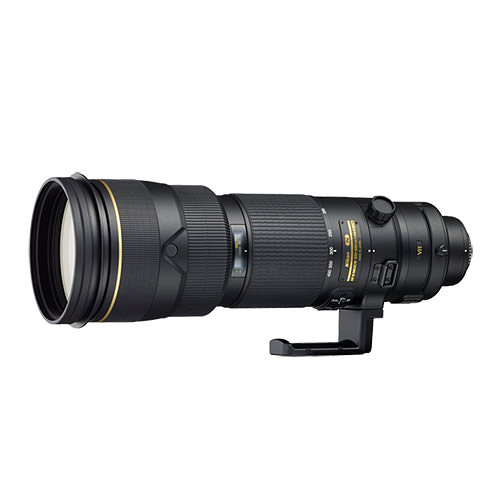
Nikon has just announced the new AF-S Nikon 200-400mm f/4G ED VR II, which replaces the legendary 2004 model. Nikon has been updating their line of super telephotos with VR II lately and this 200-400mm lens is an expected update. The last lens to get VR II was the Nikon 300mm f/2.8G VR II that was announced in December of 2009.
Key Features
- Versatile super-telephoto zoom lens – Powerful super-telephoto zoom lens that’s perfect for sports and wildlife shooting offering constant maximum aperture and VR II Image Stabilization.
- Nikon VR II (Vibration Reduction) Image Stabilization – Vibration Reduction, engineered specifically for each VR NIKKOR lens, enables handheld shooting at up to 4 shutter speeds slower than would otherwise be possible, assuring dramatically sharper still images and video capture.
- Nano Crystal Coat – Further reduces ghosting and interior flare across a wide range of wavelengths for even greater image clarity.
- 4 Extra-low Dispersion (ED) Elements – Offers superior sharpness and color correction by effectively minimizing chromatic aberration, even at the widest aperture settings.
- Three Focus Modes – A/M mode joins the familiar M/A and M modes, enhancing AF control versatility with fast, secure switching between auto and manual focus to accommodate personal shooting techniques.
- Internal Focus (IF) – Provides fast and quiet autofocus without changing the length of the lens, retaining working distance throughout the focus range.
- Exclusive Nikon Silent Wave Motor (SWM) – Enables fast, accurate and quiet autofocus.
- Nikon Super Integrated Coating (SIC) – Enhances light transmission efficiency and offers superior color consistency and reduced flare.
- Rugged Construction – Featuring enhanced dust and moisture-resistance, magnesium die-cast barrel construction and a protective meniscus front lens.
- Close Auto Focusing to 6.6 feet at all focal lengths – Focus to 6.6 feet using AF or 6.4 feet using manual focus enabling striking image perspectives.
- Rounded 9-Blade Diaphragm – Renders more natural appearance of out-of-focus image areas.
- Compatible with TC-14EII (AF/MF), TC-17EII (MF), TC-20EII (MF) and TC-20EIII (MF) Teleconverters.
Specifications
- Mount Type: Nikon F-Bayonet
- Focal Length Range: 200-400mm
- Zoom Ratio: 2.0x
- Maximum Aperture: 4
- Minimum Aperture: 32
- Maximum Angle of View (DX-format): 8°
- Minimum Angle of View (DX-format): 4°
- Maximum Angle of View (FX-format): 12°20′
- Minimum Angle of View (FX-format): 6°10′
- Maximum Reproduction Ratio: 0.27x
- Lens (Elements): 24
- Lens (Groups): 17
- Compatible Format(s): FX, DX, FX in DX Crop Mode, 35mm Film
- VR (Vibration Reduction) Image Stabilization: Yes
- Diaphragm Blades: 9
- Distance Information: Yes
- Nano Crystal Coat: Yes
- ED Glass (Elements): 4
- Autofocus: Yes
- AF-S (Silent Wave Motor): Yes
- Internal Focusing: Yes
- Minimum Focus Distance: 6.6ft.AF / 6.4ft.MF
- Focus Mode: Auto, Manual, Manual/Auto
- Filter Size: 52mm
- Accepts Filter Type: Screw-on
- Dimensions: (Approx.) 4.9×14.4 in. (Diameter x Length), 124x365mm (Diameter x Length)
- Weight: (Approx.) 118.5 oz. (3360g)
- Lens Case: CL-L2
- Lens Hood: HK-30
- Supplied Accessories: HK-30 Slip-on Lens Hood, Front Lens Cover, LF-1 Rear Lens Cap, CL-L2 Ballistic Nylon Case, 52mm Screw-on NC Filter
Nikon 200-400mm VR II vs Nikon 200-400mm VR
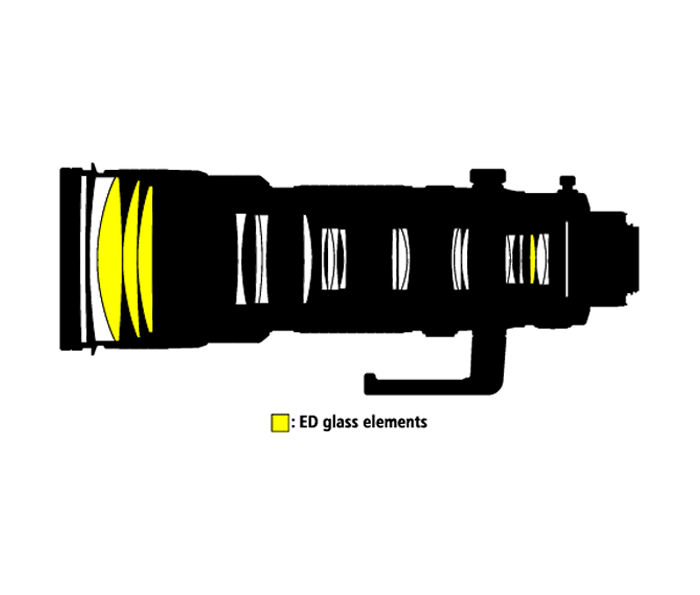
So, what are the differences between the new Nikon 200-400mm f/4G VR II and the Nikon 200-400mm f/4G VR? The only two differences are VR II and Nano Crystal Coat that have been added to the new lens – everything else, including the internal lens construction remain identical. Just look at “Tech Specs” of 200-400mm VR II and 200-400mm VR and see for yourself.
Internal lens construction of the new Nikon 200-400mm f/4.0 VR II:

Nikon 200-400mm VR II Lens Construction
Internal lens construction of the older Nikon 200-400mm f/4.0 VR:

Nikon 200-400mm VR Lens Construction
Both are identical, but Nikon screwed up a little by forgetting to put the front and rear filters in the older version of the construction diagram (both are present in the old one as well).
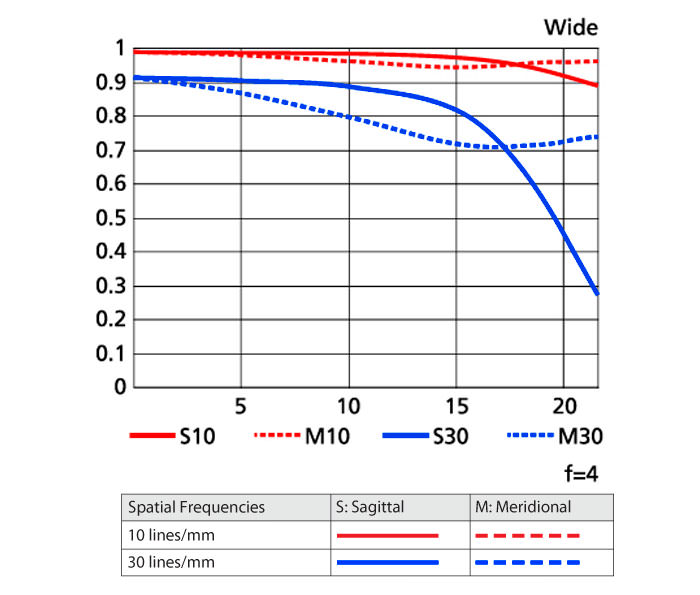
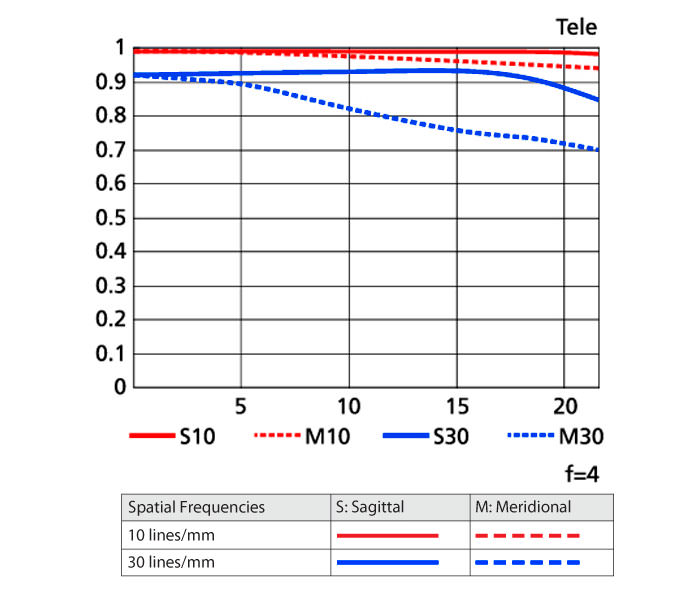
Now let’s take a look at the MTF performance of the new Nikon 200-400mm VR II:

Let’s compare to the older Nikon 200-400mm VR:

Both are identical, which indicates that there is no improvement of sharpness and contrast in the new VR II version of the lens. VR II improves camera shake by about 1 stop, while Nano Crystal Coat only reduces ghosting and flaring. The latter is not very useful for a lens like this, because I personally rarely shoot against the sun or other bright objects. The following image, by the way, was shot with the old Nikon 200-400mm VR against the sun and I do not see any flare or ghosting in the image:
So, the Nano Crystal Coat in this case is certainly a “nice to have”, but no more than that.
What about teleconverters? Again, no changes on teleconverter side and they work exactly the same way as with the older VR version of the lens. The Nikon 1.4x TC works extremely well, while with the 1.7x you start to see inaccurate focusing and image degradation, while the 2x TC is practically unusable.
Pricing and Availability
The new Nikon 200-400mm f/4G VR II will sell for $6,999.95, while the older version is currently selling for $6,099.00 at B&H. To be honest, $900 is a ridiculous difference in price to pay just for VR II technology, Nano Crystal Coat and a new faceplate. While this is a very simple fix on Nikon’s side in terms of manufacturing, charging such a huge premium for a slight update is just plain silly…
The Nikon 200-400mm f/4G VR II will be available to purchase at the end of May, 2010.
The original press release can be found on NikonUSA website.


Hi Nasim,
does seem like “mere” cosmetic changes, with a steep price increase.
I just read Thom’s appraisal, which highlights major differences between close and distant subjects: http://www.bythom.com/Nikkor-200-400mm-lensreview.htm. This may be an issue, as a lot of local subjects are quite skittish.
Before I do bite the bullet, I will rent a copy and see whether I require more reach, which may mean I’ll have to opt for the 500mm f.4
Thanks for posting this so soon!
P :)
Pasquier, I have also read Thom’s review of the lens and I can confirm that it takes some practice to nail focus when a subject is very far away. I was initially a little frustrated with the experience, but then I understood how to focus correctly with the lens and my keeper ratio increased quickly. By the way, the distant focus issue is not just with the 200-400mm lens, it happens with other lenses like 300mm f/4.0 as well.
The reason I want to sell my 200-400mm VR, is because I either want to get a 600mm VR or get a few wide-angle lenses for landscape photography (need to think where to keep my focus).
Nasim, thanks for the qucik reply.
I can well understand your reasoning – and it is a question I will have to look at more closely as well – I love birds and birding – but how much time will I really be able to devote to it – and will it warrant the purchase of such an expensive (& heavy) lens – or will it just be an additional closet occupant? But one can dream….:)
If you do really want to focus on landscape, then I guess you will have to consider a D3X somewhere in future – those large files are just amazing.
Pasquier, I am not planning to give up birding and wildlife photography, because I still have a Nikon 300mm f/4 with 1.4x TC :) But I find that 400mm is just a little short for such a heavy lens and considering that I cannot go further than 560mm, due to the fact that the lens does not go so well with other TCs, I’m thinking that the 600mm would be a better lens to go with. The only problem is the price – the 600mm is damn expensive!
As far as D3x, I’m still hoping for a cheaper, higher res FX body this year. The D3x is superb, but I do not want to invest so much money on a camera body that will be obsolete in a couple of years. I think the pricing on the D3x is too steep – if it was at $5K range, I probably would have bought it instead of the D3s…
Another thing I realize, is that if I need to get more pixels, I can still do it with my current D700/D3s setup (if there are no moving trees in the scene). Shooting four vertical images and stitching them together actually yields plenty of megapixels for large prints.
It seems like Nikon is concentrating on developing f/4 lens in the coming years.
I actually hope for a 24-70mm VRII.
Thanks for this update.
Dennis, you can rest assured that there won’t be a 24-70mm VR II in the near future…
Thanks Nasim. I read rumors about 24-120 f/4. Like you have said, it seems after 85mm, they are focusing on prime lens. Never able to follow up as new technology keeps coming.
I will go for my own preference needs. Wide angle lens follow by zoom lens.
Thanks.